First, Break All the Rules - Book Review
Recently I've been trying to read through the highlights reel of the best-regarded business books out there, and I intend to post occasional reviews. First...
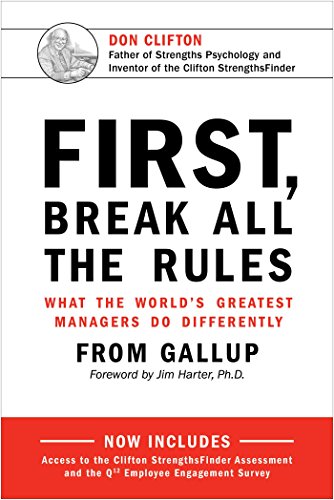
Like most business books, it's got a lot of padding. It could have been a 50 page pamphlet and lost nothing -- its only a 300+ page book because we have a social convention that books ought to be a certain yea-thick rectangular shape, and we feel gypped if we paid full price and didn't get enough book for our money.
But I credit it with driving home two big points, which I've found amazingly useful.
The first is: A whole lot of management is aimed at trying to fix people's weaknesses. This isn't something any manager can do.
I hold that it IS possible to change your personality, and to fix your flaws... a little bit. I know I have in the last ten years of our marriage, because I love my wife and it was important to our marriage. I know she's done the same for me. It's a years-long process with much groaning, false starts, and ten-steps-forward-but-nine-steps-back, and even then, its really just upgrading that characteristic from a two out of ten to a five out of ten.
That's worth doing for a marriage you intend to last fifty years. It's not worthwhile for a job which will last five. Even if it was worthwhile, its not possible within the time scope of just a couple years. Even if it was possible, it has to come from the inside -- It can't be imposed from the outside by a manager.
The conclusion is that its a waste of time for a manager to try to fix people's weaknesses. All they can do is train missing skills in people who are willing and able to learn, and try to set their people up in circumstances which play to their strengths, and minimize damage from their weaknesses.
The second point: The main thesis of the book is that authors found, through careful experimentation, a survey of 12 simple yes-or-no questions which was an extraordinarily good predictor of employee engagement
I reproduce the questions here:
-
Do I know what is expected of me at work? -
Do I have the materials and equipment I need to do my work right? -
At work, do I have the opportunity to do what I do best every day? -
In the last seven days, have I received recognition or praise for doing good work? -
Does my supervisor, or someone at work, seem to care about me as a person? -
Is there someone at work who encourages my development? -
At work, do my opinions seem to count? -
Does the mission/purpose of my company make me feel my job is important? -
Are my co-workers committed to doing quality work? -
Do I have a best friend at work? -
In the last six months, has someone at work talked to me about my progress? -
This last year, have I had opportunities at work to learn and grow?
Really, it seems to me that these can be distilled even further, to 2 fundamental needs of each employee:
-
He needs to know unambiguously what he's supposed to be doing when he comes to work each day, and have confidence that his work is valued.
-
He needs somebody at work, preferably in a supervisory role, who gives a shit about him: who cares about whether he's doing alright, what he thinks about things, whether he's learning and growing.
THOSE two fundamental needs are something that every manager is capable of addressing. Where I am now, not in a managerial role but a Technical Lead, mentoring sort of role, I'M capable of addressing those needs for the people under me.
It convinces me that the most valuable thing I can do for the people I'm responsible for is:
-
Genuinely care about them, and engage with them often enough so that they know I care and I appreciate their work. Carefully listen to what they're saying, and do my best to find them opportunities for growth if they're feeling bored or stagnant, or respite if they're overwhelmed
-
Make sure they have a prioritized queue of tasks lined up which are a good match for what they want to be doing, and if they're feeling stuck or don't know how to proceed, take time to sit down with them and get them unstuck.
I know I don't get this right all the time, but I certainly strive towards it. This gives me confidence that with practice, I could succeed in other leadership roles. Those two rules seem very common sense, but it's surprising to me the number of managers who don't do those things. Rather, it seems the default approach for a manager is to divide his employees up into "People who have a problem" and "People I don't need to worry about". He will spend a lot of his time trying to fix the people who have a problem, and ignore the other ones until he needs something from them. It's the classic "squeaky wheel gets the grease" approach to life, but it seems like its the opposite of how to lead effectively.
Subscribe to Axten Software
Get the latest posts delivered right to your inbox

