Know thyself: How I fell in and out of love with personality typing systems
Personality-type systems carry a golden promise of increased understanding, both of myself and of the people around me. They are a staple of pop psychology which I find myself fascinated with.
The typical system involves taking a multiple-choice quiz, which identifies you as being weak or strong in a few key personality traits. It then uses that information to offer you a profile of your innermost self.
Let's look at an example! A particularly popular one is the Myers-Briggs system, which assigns you a personality based along 4 characteristics.
- Extroversion vs Introversion (E or I):
Extroverts are energized by being around people. They come away from a parties feeling pumped, and are happy to go out with friends as a way to unwind after work. Introverts find their sense of energy drained by being around people, even people they enjoy. They need time alone to recharge. - Sensing vs iNtuiting (S or N)
Intuitive people tend to see the big picture, and prefer broad theories and abstract ideas. By contrast, Sensers are detail-oriented and prefer hands-on learning and concrete ideas. - Thinking vs Feeling (T or F)
Thinkers make decisions based mostly on logic and reasoning, whereas feelers make decisions based on consideration of human emotions. - Judging or Perceiving (J or P)
Judgers prefer an ordered life of lists and plans, whereas Perceivers prefer to keep their options open and delay making decisions until they have as much information as possible.
You take your letter from each trait, and combine them into a 4-letter personality type, like ESTJ. This maps to a description of a personality, which you will probably find is at least a pretty close description of who you are.
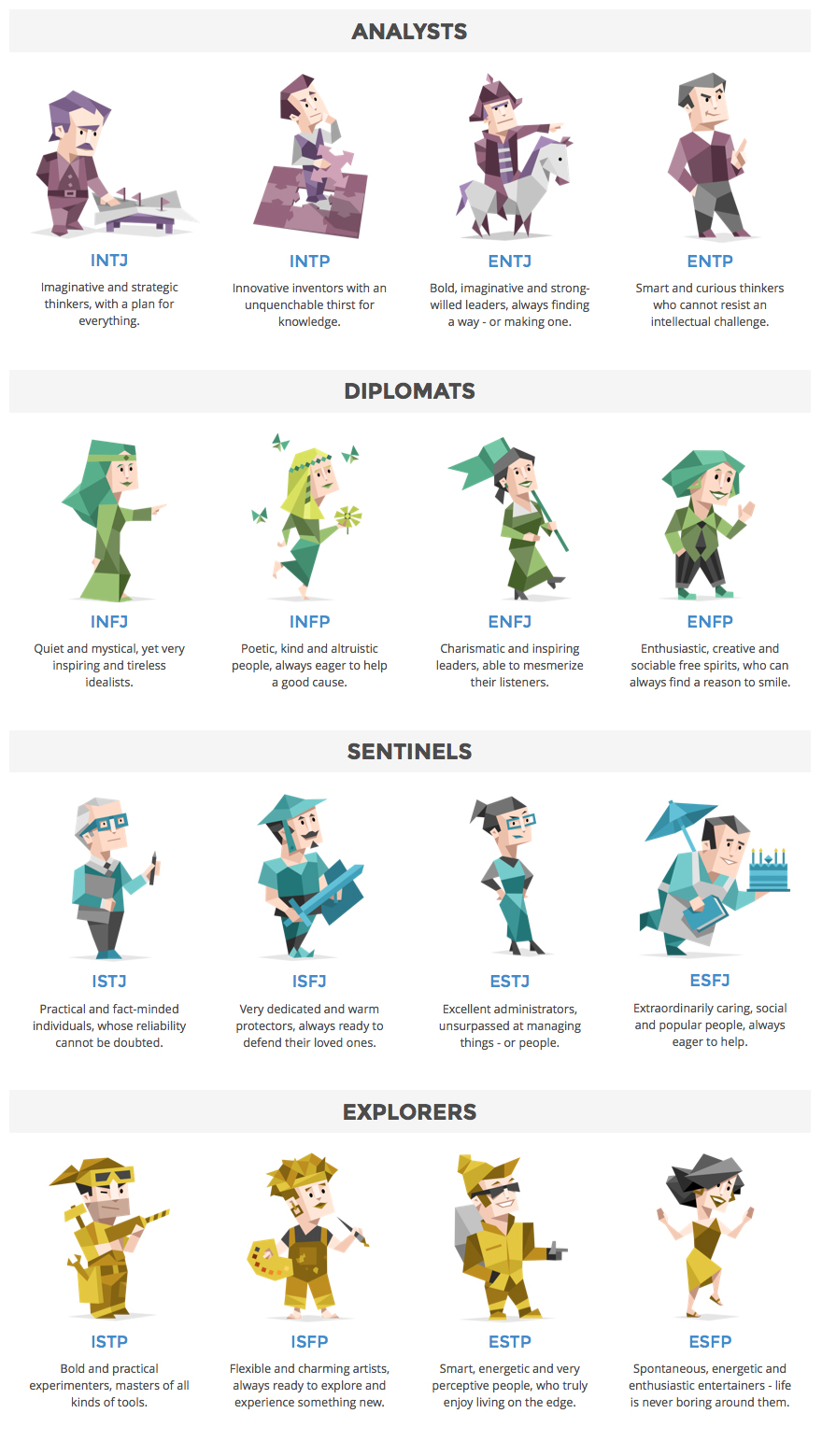
(Image source: https://www.16personalities.com/)
Its kinda cool. I encourage you to give it a try. My initial results were as an INFP, and I read the description and thought, "Yeah, that sounds like me!". But then I noticed something. If I read the the description for the neighboring personality type INFJ, I thought, "Yeah! That's even more me. Or at least I find it more flattering." I retook the quiz with that in mind, and, lo and behold, I was actually an INFJ.
I found that I could fall into any of Introverted-iNtuitive personalities, by taking a different quiz purporting to measure the same thing, or taking it on a different day, or in different mood. And really, I could find at least something of myself in all of personality descriptions associated with those. Maybe, then, I just have a strong preference for Introverted Intuition, and weak or no preference between the other two letters, and I fall somewhere amongst all the personality types outlined in that quadrant of the graph.
A little later, I found myself digging deeper, asking what the Thinking-Feeling dichotomy is really getting at. Best I can tell, I try to do both when I make decisions. I consider all sorts of factors, including the feelings of people involved, but I sometimes go with my gut over any logical reasoning that I can articulate. I think that's what most people do. It seems like a minority of people would fall strongly into one category or another: Either driven mostly by remorseless Vulcan logic, or driven mostly by passion and sentiment. I would bet, actually, that they are independent variables, and you can be strong in one, both, or neither. We feel like there ought to be a balance in the world: That the person who is intellectually weak ought to be filled with kindness and homespun wisdom, while the genius inventor ought to suffer from crippling social awkwardness. Rarely is the world fair like this. More often, the person who is talented in one thing is talented in many things.
As I think about if more, some of the distinctions between the categories are ambiguous. What distinguishes the detail-orientation that powers the list-making Judger, and the detail-orientation that underlies the Senser? What's the difference between decisions based on iNtuition and decisions based on Feeling? It seems like there's a good bit of fungibility between the last 3 letters of the type. They can all be taken as describing a preference for the concrete (Sensing, Thinking, Judging), vs the fuzzy and abstract (iNtuiting, Feeling, Perceiving). In practice, this gives a lot of wiggle-room to tilt yourself into whichever type you like best.
I also noticed that all the Myers-Briggs types made much more sense when I tried applying them to myself than when I tried applying them to other people. If you read the various descriptions, you don't come away thinking, "Oh yeah! I knew a guy who was exactly like that." When you compare two people who have the same type, they often don't seem to have much in common.
This led to a disappointing realization: All the personality descriptions associated with Myers-Briggs types have the same sort of flattering vagueness as personality descriptions associated with being a Scorpio, a Gemini, or a born in the year of the Dog. Many of the points they describe follow the pattern of, "Though they may seem {some trait} on the surface, friends who get to know them will realize that they really have a strong streak of {opposite trait}" Anybody who is a mix between {some trait} and {opposite trait}, which is everybody, will be able to identify with this.
I've ended up with similar impressions of other personality typing systems I've looked into. But in the end, I still enjoy them.

They can prompt interesting discussions, and illuminate personality traits and tendencies I hadn't even considered before. Where they fail is in trying to extrapolate a generalized personality type from a few specific traits. Being an ENTJ doesn't mean you match up with the fundamental human archetype of the Fieldmarshal, it just means you are extroverted and a have a particular combination of preferences between concrete and abstract ways of approaching the world. In this system, being someone who responds to internal motivation means you are someone who responds to internal motivation, but it doesn't mean you conform with the personality type of the Questioner.
Interestingly, there is one personality system, which DOES seem to reach a little deeper. I refer here to the Big Five personality traits, also known as OCEAN or the Five-Factor Model.
This system is less ambitious than say, the Myers-Briggs system. While Myers-Briggs is a popularization of Jungian psychological theory which purports to really get at the meat of how people think, Big 5 doesn't attach to any underlying theory about where its traits come from. It's more inductive. It's really just derived from psychologists asking people thousands of questions about their personality and preferences[1][2]. When they do this, they notice a few big clumps of traits which have a tight statistical correlation with each other.
For example, it seems that one clump of attributes includes things like punctuality, responsibility, carefulness, orderliness, rule-following, thoroughness, focus on goals, self-discipline, and attention to detail. If you have one of these attributes, you are more likely to have others. Many studies indicate that this statistical clumping is pretty universal in human cultures around the world, and the degree to which individuals align with the clump tends to stay pretty constant over the course of their lives. Most people will also intuitively notice that all of these attributes seem interrelated. Psychologists theorize that there is one underlying trait which influences all of them. They give it a name which seems to capture the gestalt of those attributes: Conscientiousness.
There are four other traits they identify in the same manner. Together, they go by the acronym OCEAN. They are:
- Openness to Experience: The degree to which you appreciate new experiences. Associated with curiosity, creativity, imagination, and adventurousness
- Conscientiousness: The extent to which you feel compelled by duty and order.
- Extroversion: The extent to which you draw energy from being around other people. Associated with assertiveness, talkativeness, and enthusiasm.
- Agreeableness: The tendency to be considerate of the feelings of others, to cooperate, and to avoid conflict.
- Neuroticism: The tendency to experience negative emotions strongly, particularly stress and anxiety.
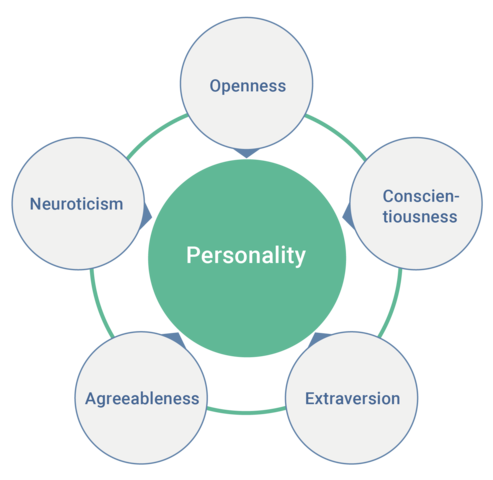
The Big 5 traits have gathered widespread acceptance among psychologists as a pretty decent measure of personality. They succeed in a number of things that popular personality systems fail at. The Big Five characteristics are fairly stable throughout our lives. Anecdotally, it does seem that if you meet two people who have a similar Big Five profile, you really do get a sense that they have pretty similar personalities. But nonetheless, The Big Five system has failed to capture the popular imagination the way the Myers-Briggs system has.
I can think of a few reasons for this. The Horoscope-like personalities that come out of a system like Myers-Briggs tend to be flattering, but also balanced. Sensing isn't better or worse than Intuiting. The two are like yin and yang; masculine and feminine; heads and tails. It takes both to make the world go 'round.

The Big Five system, by contrast, indicates something which we all knew but didn't want to admit: That some people just have better personalities than others. I think most people would look at someone who's Extroverted, Conscientious, and Agreeable, and say that's a preferable personality to being Closed-minded, Neurotic, and Disagreeable[3]
Also, most personality systems give a solid sense of identity, of resolution, with their either-or dynamic. Even though both Big Five and Myers-Briggs recognizes Extroversion vs Introversion as being a key trait of personality, Myers-Briggs asserts that most people fundamentally fall into one category or the other. Big Five theory sees people as being distributed across a spectrum. Only a minority of people are going to be strongly extroverted or introverted. Most will be somewhere in the middle, with a moderate leaning one way or the other. It also seems to imply that having a personality which is too extreme towards one pole can lead to troubles, even for a generally positive trait like Conscientiousness (eg, becoming a rigid perfectionist or a workaholic).
Its interesting to me that the things which hurt the truthiness of the Myers-Briggs system are the very things that make it so compelling. What we really want is a personality inventory which gives us deep insight into what makes us all tick, not just a comparison of characteristics. And it seems that, much as we would wish for it, that's something which psychology has not yet produced.
http://news.fitability.com/core/item/page.aspx?s=17622.0.44.24 ↩︎
https://books.google.com/books?id=UzXvvAsESjEC&pg=PR13&lpg=PR13&dq=The+curious+history+of+the+five+factor+model&source=bl&ots=br9TGnwrD3&sig=rCxNKIabO6xSYz5za7VwPEOHrZ0&hl=en&sa=X&ved=0ahUKEwjiouLu27rcAhWMLnwKHXsvA3MQ6AEINjAC#v=onepage&q&f=false ↩︎
Though, I'd argue, its not as bad as it sounds. For example, in our society we have a tendency to equate agreeableness with personal goodness. I don't think we should. There's actually some research indicating that disagreeable people are more likely to do to the right thing in difficult ethical situations. For an example of someone who seems fundamentally good, but also disagreeable, just try watching a video of Jordan Peterson. ↩︎
Subscribe to Axten Software
Get the latest posts delivered right to your inbox

