How to make remote work........work!
I love remote work. If you've been following this blog, you probably know this. Around 2 years ago, I decided to bend all my professional ambition into landing a job which would allow me to perform the majority of it from my home.
Or, you know, anywhere else with internet access.

By the time the COVID rolled around, I had already been working 100% remote for well over a year. And now, we landed ourself in this strange situation where everybody is working remote. As the pandemic is running its course, lots of us are starting to settle in for the long haul, with plans to stay away from the office till 2021 and beyond.
I should put a caveat here: These are the things that have worked for me. I'm not a great sample of the general population. This is also drawing on my experience specifically of being a programmer while remote. Take it with a grain of salt, and of course, comment to let me know where I'm wrong!
The first thing is, I want to reassure you: These are tough times. Remote work is usually better than this.
So many of the things which make it fun and productive aren't available during the pandemic. With everybody else locked down alongside you, with schools closed, with your spouse needing to share the same workspace, its hard to quietly concentrate. For all the benefits and troubles of remote work I outline below, COVID makes all the troubles more troubling and all the benefits less beneficial.
All of this is to say, if you find remote work even tolerable right now; if you think "I love the flexibility, but (I never thought I'd say this) I wish I could go into the office at least once in a while" ...
When this COVID crisis is nothing but a memory, you're going to love remote work. Don't let go of the dream just because things are rough now.
How To Thrive when working remote
Embrace the flexibility
If you browse your news feed for articles on working from home, you will find yourself with an article from Business Insider or something, with some anodyne tips which more-or-less advise you to recreate the office in your home. They will have bullet points like "Don't let yourself get distracted by doing the laundry during work hours" or "Make sure you have a dedicated room which simulates your cubical in the office"
I think this is mistaken, and sacrifices one of the biggest benefits of remote work.
Remote work gives you enormous freedom. Do you need to a half-hour to head to the grocery store when its not overflowing with people? Keep the laundry moving between sprints of work? Go for a run mid-afternoon (and come back all stinky and sweaty in a way no office would tolerate)? Pick the kids up from school at 3, and then finish your workday later in the evening? You will love your job, and love your life more, if you take advantage of the freedom to do all those things.
Working remote adds an entire hour back to your day, which would normally be lost to a commute. Odds are, that hour you spent fighting traffic was the least pleasant of your day. You weren't enjoying yourself, you weren't resting, and you weren't doing anything useful. Take advantage of that extra time.
Here's a routine which has worked very well for me: When I worked in an office, I'd arrive at about 8:30, and leave at about 5:30, with an hour off for lunch in the middle. Then, there would be a half-hour of commuting on either end of that. Now that I'm remote, I roll the time I would have spent commuting into the work day. In other words, my hours are 8 to 6. But then, I take 2 hours off in middle of the day. This allows both time for lunch, and time for another substantial break. I'll use that break to exercise, or go for a long walk, or run an errand. Having those periods of rest helps me work with maximum energy, to my best self, throughout the day. I'm no longer exhausted by the end of the day, limping through the final hour before quitting time.
It's surprising how much discipline it takes to take breaks like this. It involves silencing that nagging worry "What if there's an emergency? What if my boss Slacks me while I'm out, and I'm not there?". Just take a reasonable amount of time, set your Slack to an away status to let your colleagues know when to expect you back. And go for it.
But create some space where you're not worrying about work
Flexibility comes with a downside. It brings with it a temptation always be "on". It's the temptation to never really disengage from work, to always be ready to respond to an email.
This is dangerous. It's not hard work that leads to burnout; it's that non-stop vigilance — the inability to ever really rest.
Here's the answer: Delete Slack from your phone. Set your phone up so that you can't use it to check your work email. If you absolutely must get notifications on your phone during the day, get a separate work phone, and make sure the work phone is turned off when you're not on call. Don't merely resist the temptation of checking Slack; arrange your situation such that Slack isn't even available, so you're not wasting energy avoiding the temptation. If you need to, keep a separate work computer and home computer. Put on a button-up shirt for the workday, and ceremoniously take it off at quitting time.
Because nobody has a right to demand your 24/7 participation. Nobody needs that. Nothing you're involved in is so critical it can't wait until tomorrow morning. In fact, by replying to an email after hours, you are placing a burden on whoever you're replying to. The ball's in her court now. She might receive a ding on her phone, which will break her concentration on something she was enjoying, which will cost her a whole hour of rest.
That was inconsiderate of you. None of that worrying you caused her is free. The piper will have his pay eventually, and he will extract it in the currency of exhaustion and burnout.
Move around
This is harder to do during this pandemic, but I find it's important to do it anyway. I thrive on being able to move throughout the day, to move with my laptop to different rooms in the house. In between sprints of work, I'll pace, do push-ups, mosey outside for ten minutes. Pre-pandemic, I would rely on wandering out to coffee shops and libraries, or just my apartment's common area. It's amazing to me how a change of scenery can turn an unproductive day into a productive one.
Here's a useful hack I've found, now that a lot of public spaces closed due to COVID. I have my phone set up to act as a wi-fi hotspot. Sometimes, I'll just drive to a park with a view of a lake. I'll keep the car idling and the air-conditioner blasting, tether my laptop to my phone, and just spend a couple peaceful hours working from my tiny little automotive office
Things that are tough when you're remote (and how to work around them)
I think if you had asked most managers pre-COVID why they don't want their people to work remote, they would have said something like,
"What? Nobody's going to get anything done if they're lazing around in their pajamas with the TV just a click away. They need to be in the office for accountability. Besides, we've got a very collaborative culture around here. If we want to figure something out together, we need to be able to just grab a conference room and work it out on a whiteboard"
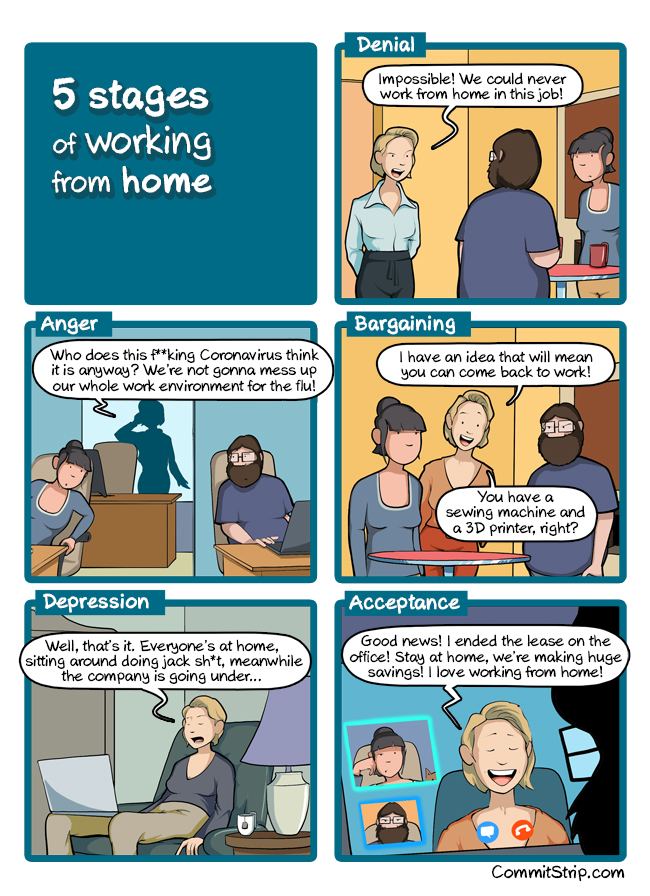
I think we've discovered by now that most of those objections are baloney. You and your coworkers are professional adults, and you are perfectly capable of staying on task without the threat of the boss stalking the aisles and calling out anybody who doesn't look busy. Cube farms were never productive environments, and open-plan offices were even worse. They were uncomfortable, anxiety producing, and filled with distractions.
This pandemic makes it hard to have a comfortable work-from-home environment, with schools closed and with your spouse sharing the same workspace. But even so, you are likely finding that your home is a better environment for work than the office ever was.
Likewise, that thing about a collaborative culture. Do you remember those times back at the office, where you piled into a conference room, and something magical happened? Where the ideas flew like fireworks as you took turns drawing on the whiteboard -- some ideas fizzling out, but others joining together, building and building into something more than the sum of their parts; sometimes blossoming into entirely new products, concepts, opportunities? Where sometimes you would bump into a stranger in the hall from a whole different department, and your small talk would turn to talk about your different projects, the problems you're solving and their solutions, where sometimes your solutions would marry and their offspring would be an amazing new solution neither of you could ever have dreamed of alone?
Admit it. You never actually did any of that in your office. That's a stock photo from your company's sales brochure, not an actual experience you had.

The reality is a little more boring. You didn't really "collaborate" all that much. Programming is intensely individual work. Instead, you tended to reach out to people when you had a question, when you were lacking information necessary to complete your task at hand, or when you were unsure exactly what you were supposed to be doing. You would discuss a specific problem to try to reach a decision. You would also get sucked into a lot of meetings, some of which were necessary and some that were entirely useless.
Most of that is surprisingly well accomplished with Zoom. In fact, in some ways, Zoom works better than in-person meeting. Screen sharing can work better for getting two sets of eyes on a tough piece of code than having bunch of people craning over a monitor. Zooms are just enough extra effort that people seem a little less inclined to call useless Zoom calls than to call useless meetings.
And yet.... even so, there is something very critical lost when you never see your colleagues face-to-face.
The number 1 difficulty: It's hard to learn to like and trust people who you don't get to see face-to-face
It's not as simple as "People aren't communicating/collaborating while remote". This Harvard Business Review article seems to find that we collaborate very well...... with the small set of people who we're actively collaborating with. What we miss is the weaker connections. It's the smiling and waving "Hello!" in the hall to a guy who... I've seen him around, but I don't even know his name. It's the noticing the new guy a couple cubes over is struggling with some gnarly git issue, and taking ten minutes to show him how to solve it with an interactive rebase. He's on a whole different team -- We don't work on any of the same projects. If we were remote, I might not even have known he existed.
These tiny, routine bits of positivity add up. It's not that brilliant ideas spawn from them, its that the sum total of months of these interactions helps produce a feeling of belonging. It can give an office a sense of "This is a place where people smile when I walk by, where I know these people. This is my tribe."
I think we miss those small interactions even more with the people we do regularly collaborate with. Marriage counselor John Gottman found in his research that, for a happy marriage, positive interactions need to outnumber negative interactions by nearly 5 to 1. I believe this applies to all relationships, not just marriages. When everybody is remote, its easy to slip into a pattern of only communicating with people when there's some kind of a problem: Either a complaint about their work, or a frustration we want their help resolving.
I'm going to link to the same HBR article again, its that good. Pre-pandemic, we would have thought that Conscientious, Introverted people would be the ones who would thrive best while working remote. What these authors found instead is that the most useful personality traits are Agreeableness and a lack of Neuroticism. In other words, it the personality tendency to get along easily, and not to interpret things in a negative light, which makes the biggest difference
Maintaining strong relationships is the single biggest challenge of remote work even during normal times, and the pandemic makes it harder. Far and away the best antidote to this problem is to have real get-togethers. All the separated remote workers should travel to meet up together at least once a quarter. A couple days dedicated to spending time with each other can do more to build camaraderie than months of mumbling about the weather as you grab your coffee. It's hard to get really mad in an argument over javascript semicolons if you have the shared experience of winning the relay race at the company picnic, of getting lost trying to find your way back to the hotel after happy hour.
In COVID times, I've found the best thing I can do is to reach out to people when I don't need something from them. It's the art of giving people a call and asking about them, of being sincerely interested in what they're working on and what's going on in their lives.
I find it also helps to just put extra effort into being funny. On the shared team slack, keep making jokes. Keep the giphy's flying. Keep posting cute pet pictures (and especially cute baby pictures). Show up early to Zoom meetings, and take a little time to tell a funny story. Thank people for their hard work, and be generous with sharing credit. Build up the score of those small, positive interactions, so that when you do need to criticize, its a gentle correction from a friend, not an attack from a stranger.
Thing that's difficult #2: People are anxious.
Odds are, there's a pall of worry cast over your entire workplace. Everybody is worrying about their job security, about declining revenues. They're worried about their kids falling behind in school, and worried about the health of their parents. They're frustrated because they're not feeling as connected with their co-workers as they were a few months ago.
And its not just the people you work alongside. Things are even worse for managers. Remember, most of the purpose of an open-plan office is to to reassure managers that their people are busy and collaborative. They're dealing with all those normal human worries, and on top of that, they're worrying about their employees. Are they busy? Happy? Talking with each other? Are they getting anything done? If they are, is it the right thing?
Anxious people tend towards inaction, and inaction makes the frustration worse. Anxious people tend to interpret more things in a negative light, which makes it that much harder to strengthen relationships.
Thing that's difficult #3: Remote work isn't for everybody
I was home-schooled for most of high school. I remember it as one of the best experiences of my life. For the first few months, it didn't seem real. It felt too good to be true, like one day everyone would jump out and yell "April Fools!" and I would have to go back to school again. I spent the next 4 years just happily learning, making friends with other home-schoolers, being happier than I could ever remember being.
(This experience was one of the things that tipped me off that I might prosper as a remote worker)
My dear wife Amy, on the other hand, had a radically different experience. She was home-schooled for a few years in middle school, and she hated it. She was desperate to go back to a real school.
I think remote work is like this. Some people legitimately need the bustle and energy of an office in order to thrive. They feel stymied; despondent being away from it. Very competent professionals are going to have radically different reactions to the same experience
In most times, remote workers would be a self-selected group of the people who get the most out of remote work. Now, we're all thrust into it, whether we like it or not.
For both of these difficulties, the best advice I have to offer is not easy advice. It's to be generous to your colleagues. Try your hardest to give them the benefit of the doubt. If a manager is unclear or unavailable or short-tempered, assume he's extra-stressed figuring out how to manage a remote team, and he'll be back on track when the office eventually reopens. If a co-worker is struggling to explain her problem over Slack or Zoom, assume that she misses face-to-face, not that she's a bad communicator.
Subscribe to Axten Software
Get the latest posts delivered right to your inbox

